
What is an e-invoice?
E-invoice is a machine readable bill. In general, it’s in XML format, but it doesn’t necessarily have to be like that. The Estonian e-invoice standard is XML and its use allows the user to send an invoice from one system to another so that the receiving party doesn’t need to enter any data manually – no contact information, invoice content, etc. This means that the entire invoice content is inside the e-invoice.
Although e-invoice is a machine-readable document, it doesn’t solve all the accounting problems in the world. For example, Estonia’s e-invoice is not ideal for delivering stock invoices because there is no possibility to add different product codes there. Thus, the use of the e-invoice can often be seen, in particular, in case of different expense invoices.
How does e-invoicing work in general?
E-invoices are generally sent through the e-invoice operator. This is a so-called information exchanger to whom the e-invoice is sent and who will forward it either to another operator, or if the customer uses the same operator – directly to the end customer. For further information, operator service is not required when two accounting programs can receive e-invoices via email. This is possible in ERPLY Books because all essential operator functionalities are built into the software:
Automatic digitization service – If your vendor sends an invoice in the form of an e-invoice, everything is fine because it can be downloaded directly to ERPLY Books and if all information is present, generally no additional steps are required. But what if the vendor sends the invoice in PDF format? Or an employee sends an expense receipt to the accountant? These documents are not in the form of an e-invoice and must be manually entered into the software by the accountant. Maybe it was possible to automate the work of the accountant so that they would only need to set up accounts for expenses, and not start re-entering the whole invoice? The previously described process is called digitization service. This is still a manual interface where someone enters the information and makes a machine-readable e-invoice. And then, since the e-invoice is machine-readable, the accountant may only deal with account allocation and other activities that are specific for the company and cannot be automated.
Invoice approval – a process where purchase invoices are reviewed and approved before payment and before they are posted into accounting
Assignment of dimensions and accounts
E-invoice in ERPLY Books
ERPLY Books supports all major e-invoice processes:
- Sending a sales invoice as an e-invoice
- Receiving a purchase invoice as an e-invoice
- Integrations with multiple e-invoice operators
ERPLY Books supports all major e-invoice versions that are currently available:
- 1.0
- 1.1
- 1.2 – Default version when the sales invoice is downloaded as an e-invoice
Supported operators or other service providers:
- Tsekk.ee – digitization of purchase documents
- Envoice – digitization of purchase documents
- Omniva – sending sales invoices, receiving purchase invoices
- Fitek -– sending sales invoices, receiving purchase invoices
- E-arveldaja – sending sales invoices, receiving purchase invoices
- Billberry – sending and receiving e-invoices (default)
How to start with e-invoicing?
The e-invoicing solution depends on your needs. If the customer is willing to receive e-invoices via email, no additional integration is required, and you can send the e-invoice directly from ERPLY Books’ Purchase Inbox to the customer via email.
If you want to use an e-invoice operator for sending invoices, ERPLY Books uses the Billberry integration by default. However, activation requires completing the KYC (Know Your Customer) procedure. At the same time, ERPLY Books does not limit the use of other operators. Below are the available options:
- Purchase inbox – ERPLY Books internal functionality that you definitely need to use.
- Finbite – here is a tutorial in Estonian language.
- E-arveldaja – The E-arveldaja integration allows sending XML invoices to customers without using a traditional e-invoice operator such as UnifiedPost or finbite. This solution is mainly intended for customers with a low invoice volume who do not want to adopt additional software. E-invoices are sent from Books to E-arveldaja, which then forwards the e-invoice to the customer’s operator. Read more about E-arveldaja here.
- UnifiedPost – needs a specific setup. Please contact info@erplybooks.com.
- Envoice – find the tutorial here.
- Billberry – enables sending and receiving e-invoices. E-invoices are sent from Books to Billberry, which then forwards the e-invoice to the customer’s operator. Read more about the solution here.
NB: If the entire purchase or sales process is managed in ERPLY Books and you do not want to pay additional fees for an e-invoice operator, you can use either Billberry or E-arveldaja for sending e-invoices.
Purchase invoices
ERPLY Books supports receiving e-invoices from vendors in the following ways:
- The vendor may send an e-invoice directly to the Purchase Inbox. It’s that simple. No additional e-invoice operator required.
- You can receive e-invoices from the following operators:
- finbite (synchronisation with ERPLY Books)
- UnifiedPost (synchronisation with ERPLY Books)
- Envoice (e-invoice is sent)
- Billberry (synchronisation with ERPLY Books)
When an e-invoice is issued by the operator, the e-invoice file is attached to the purchase invoice in ERPLY Books.
Sales invoices
All options:
- you can send e-invoices one by one to the customer
- can send multiple e-invoices to customers
- can be sent directly through Books
- can be sent through UnifiedPost, Omniva and Envoice
- We can activate Billberry (or E-arveldaja) integration, so that you don’t need to have a seperate e-invoice operator such as UnifiedPost või finbite.
- The process of e-invoicing can be fully automated:
- Every night ERPLY Books checks if there are invoices that hadn’t been sent out
- System checks if there are invoices that need to be sent as e-invoices
- System sends them directly to the operator service
- Automatic sending is also related to other alternative ways of sending invoices, such as invoice planner or manually sending invoices. During the process, ERPLY Books checks in which format customer needs to receive the invoices. E-invoicing is one of the several different approaches (others include PDF via email, e-invoice via email, and also factoring that needs its own specific setup)
Sending e-invoices from ERPLY Books one by one:
- To send an e-invoice by email, open the invoice, click on the envelope icon and select the option Add e-invoice
- To send an e-invoice to a partner service, you need to:
- Set up partner service (Settings > Integrations)
- Open an invoice and select the operator from the Send menu
- Full automation of the partner service needs a separate onboarding. The price list can be found at our homepage. For this, contact info@erplybooks.com
In order to send e-invoices automatically from ERPLY Books:
- Write to info@erplybooks.com about it
- Together we will add rules how to recognise customers, who need e-invoices
- Together we will add rules how to exclude specific invoices from sending
- We will check if invoice templates and data match your needs
- We will set rules how to recognise new customers for e-invoices
- If necessary, with the same setup we will set up rules for automatic email sending also (because ERPLY Books can track if the email was received and opened)
- This setting has one time fee of 599 EUR
General e-invoice setup in ERPLY Books:
- GLOBAL_ADD_ATTACHMENT_TO_EINVOICE – if it is on, the PDF file will be added to the e-invoice
- Finbite:
- default version that is sent to Omniva is 1.2
- If you want to send version 1.1 to Omniva, you need to add ATTRIBUTE_GLOBAL_OMNIVA_VERSION12
- If you don’t want to synchronize non-confirmed purchase invoices, you need to add GLOBAL_EINVOICE_IGNORE_NOT_CONFIRMED
- UnifiedPost: Generally needs additional training and onboarding. Please contact info@erplybooks.com for this matter
- GLOBAL_SAVE_FAILED_EINVOICE – If the e-invoice synchronization fails, they will be added to your Purchase Inbox
- If you use Erply POS, it is wise to add a PartnerAPI solution that allows you to monitor which invoices have already been sent to the operator and which ones are not.
- If you want to send an invoice via email so that the e-invoice will be attached also:
- By default e-invoice is not attached. To attach it, you need to check Add E-invoice while sending out your invoice.
- If you wish that latter checkbox is always filled, go to Settings > Configuration and enable Add automatically e-invoice into sales invoice email if possible.
- If you don’t want to see any PDF in your email (you only want the e-invoice to be attached), go to Settings > Configuration and enable Add only e-invoice when sending invoice (PDF will be embedded to e-invoice if possible)
Sending E-Invoices to Europe
If you want to send e-invoices to Europe, the following settings must be configured in ERPLY Books:
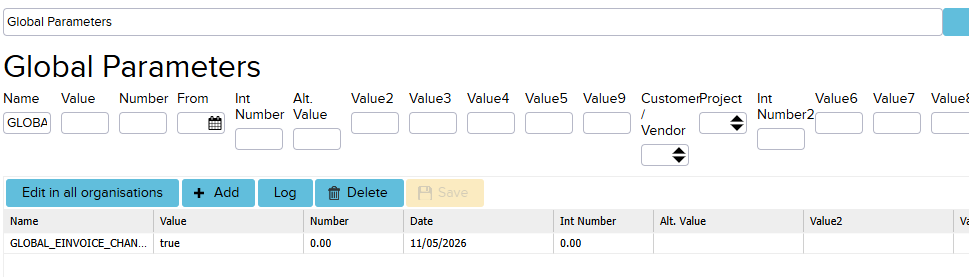
- Add a new rule under Global Parameter. You can open Global parameter from the dashboard search field. Then click the blue “Add” button to create a new row and fill in the fields as follows:
- Name: GLOBAL_EINVOICE_CHANNEL
- Value: true
Save the changes and log out and back into your account for the setting to take effect.
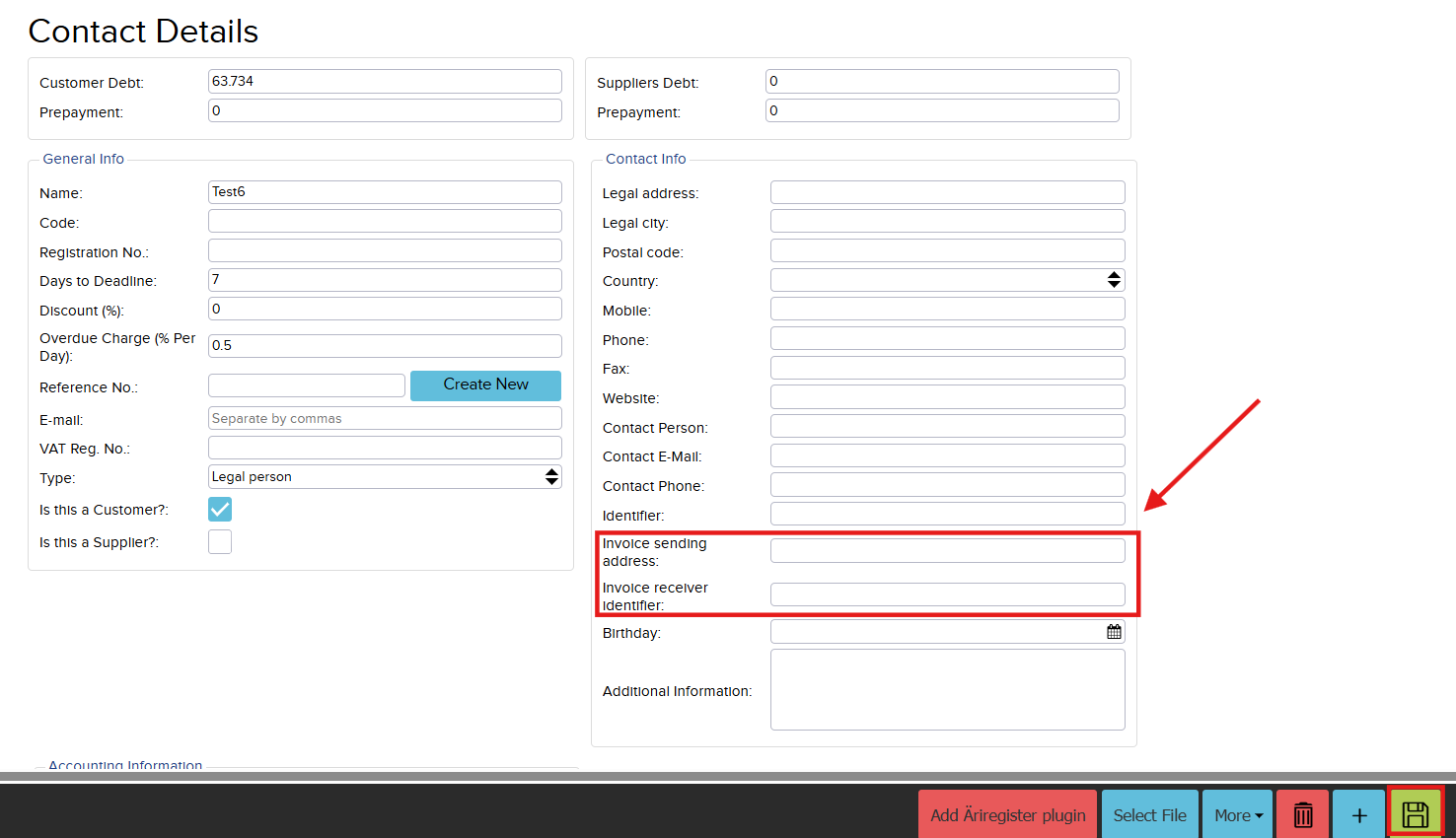
Add the Peppol ID to the “Invoice sending address” field on the customer card and if necessary, add the relevant customer operator to the “Invoice receiver identifier” field.
For example, in Finland a business ID (Y-tunnus) is usually sufficient as the PEPPOL ID. However, when sending invoices within Europe, PEPPOL may not always know which recipient to match or where to route the invoice. In such cases, the customer must provide the necessary information to fill in the “Invoice receiver identifier” field.
You can open the customer card by going to the main menu “Sales/Purchases → Contacts” and clicking the “i” icon next to the relevant customer.

- Add the Peppol ID to the “Invoice sending address” field. The Peppol ID can be obtained from your e-invoicing service provider (E-arveldaja; Finbite ; Fitek).
- Save the changes.
Integration and Monthly Pricing
To set up an integration between ERPLY Books and an invoice operator or service provider, you must first register a user in ERPLY Books.
The monthly cost of ERPLY Books depends on the selected package. It is important to note that with the “Choose yourself” option, you must explicitly select the e-invoicing feature, which can be found under the pricing plans. In the Medium and Large packages, this feature is already included by default.
You can find more detailed information about pricing plans here. The integration itself is free of charge. To start using an e-invoice operator or service provider, you must sign a separate service agreement with them (except for E-arveldaja and Billberry). Pricing information can be found on the service providers’ websites.
Supported operators or service providers:
- Costpocket – digitization of purchase documents
- Envoice – digitization of purchase documents
- Finbite – sending sales invoices, receiving purchase invoices
- UnifiedPost – sending sales invoices, receiving purchase invoices
- E-arveldaja – sending sales invoices, receiving purchase invoices
- Billberry – sending sales invoices, receiving purchase invoices
Therefore, the monthly cost of e-invoicing depends on the selected ERPLY Books package and the service provider’s pricing plan. If you would like assistance with setting up all e-invoicing processes, creating integrations, or receiving training on the topic, you can find more information here.
ERPLY
ERPLY software customers can use different data and invoicing hubs within ERPLY. You can find more information about them on the ERPLY website: https://abi.erply.com/
To get more detailed information about ERPLY data and invoicing hub integrations, please contact ERPLY support: http://ee.erply.com/kontakt/